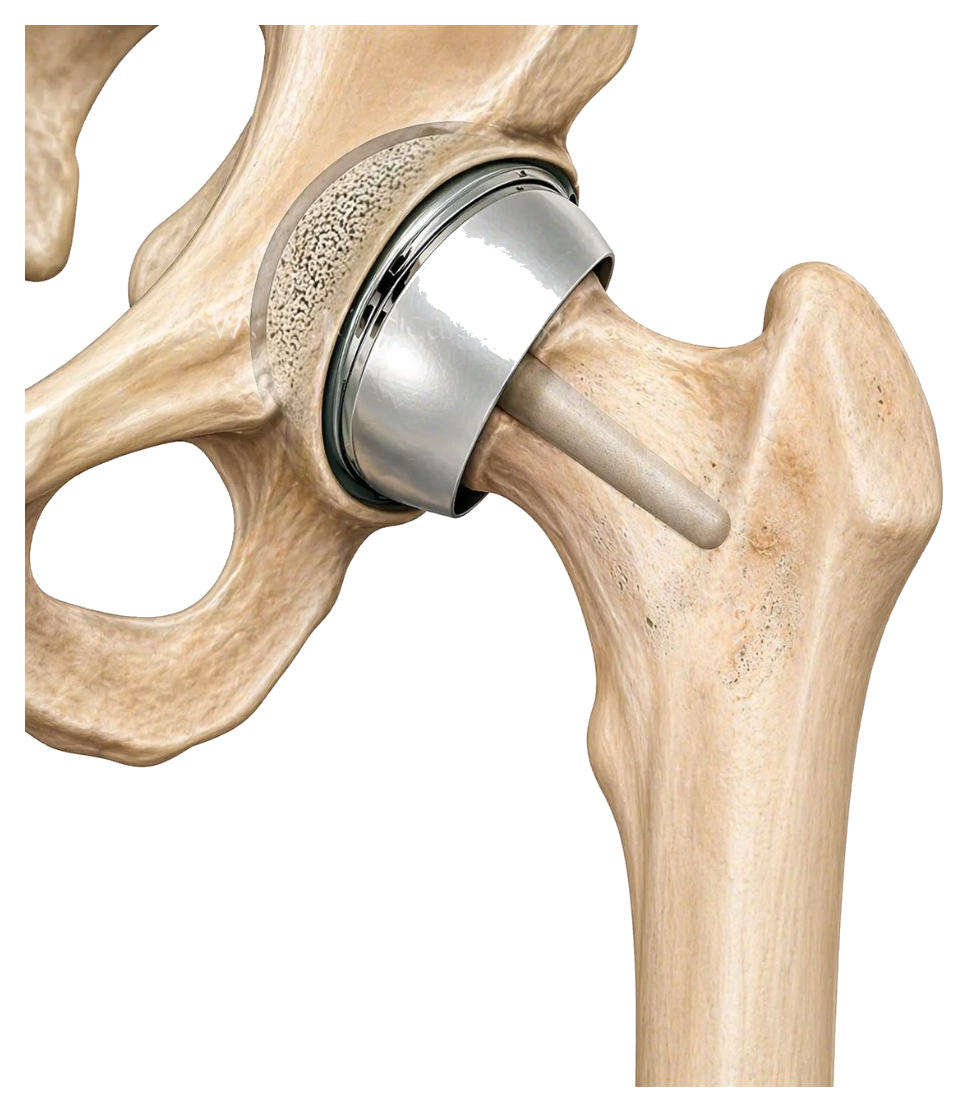
Bone-preserving alternative to hip replacement for active patients.
Hip resurfacing is a bone-preserving alternative to traditional total hip replacement. Rather than removing the entire femoral head and replacing it with a ball on a stem, the worn surface is capped with a smooth metal cover, preserving the natural femoral neck and most of the femoral head.
For the right candidate, typically an active patient under 60 with good bone quality, resurfacing can offer a more stable, higher-impact hip that preserves future options. It is a technically demanding procedure and is best performed by high-volume specialists.
Not every patient is a candidate. Ideal candidates are active men and women under 60, with strong bone quality and no significant cysts or deformity of the femoral head.
3D imaging is used to size the resurfacing cap and plan femoral neck preservation. The goal is to restore native hip geometry as precisely as possible.
The worn surface of the femoral head is shaped and capped with a metal resurfacing component. The acetabular socket is also resurfaced with a mating component.
Hip range of motion and stability are tested through the full arc before closure. The preserved femoral neck provides inherently greater stability than a standard replacement.
Timelines are typical, individual recovery varies based on age, health status, pre-operative condition, and adherence to physical therapy. Dr. Debbi will give you a personalized recovery plan.
I'm 46 and still compete in triathlons. I didn't want a stem inside my femur for the next forty years. Dr. Debbi is one of the few surgeons in the country who still does resurfacing for the right patient. Nine months later I finished a half-Ironman.
I did a lot of research before choosing resurfacing. Dr. Debbi was the only surgeon who gave me a clear answer on candidacy, bone density, anatomy, activity, and didn't push me toward a standard replacement. Grateful to still have my femoral head.