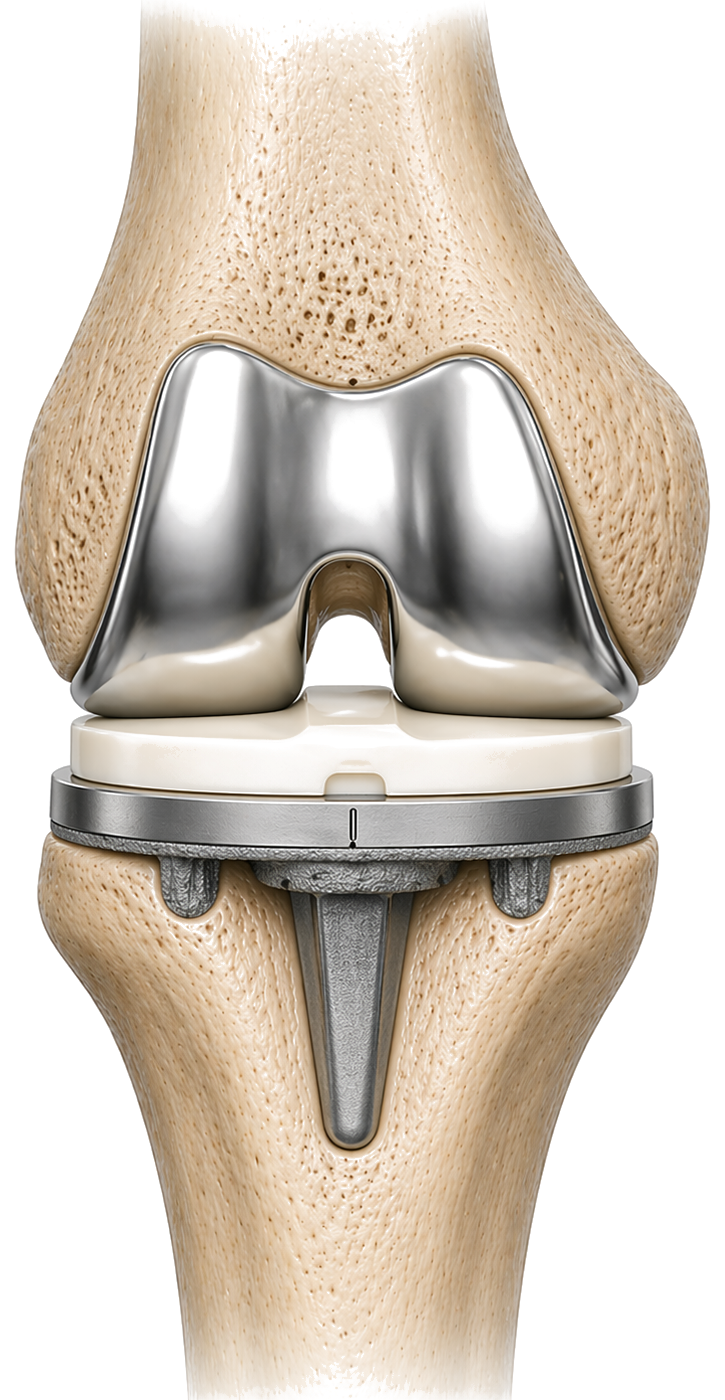
Robotic-assisted knee replacement with patient-specific 3D alignment planning.
Total knee replacement resurfaces all three compartments of the knee joint. The worn ends of the femur and tibia are replaced with precisely-machined metal components, and a highly-crosslinked polyethylene bearing is placed between them to replace the lost cartilage.
Dr. Debbi performs every primary knee replacement with robotic-arm assistance and a patient-specific alignment plan. A pre-operative CT scan of your knee is used to build a three-dimensional model, and the implant is positioned to match your unique anatomy, not a standardized template.
A low-dose CT scan is used to build a millimeter-accurate 3D model of your knee. Implant size, rotation, and alignment are planned in software before the first incision.
During surgery, the robotic arm provides a physical boundary, it cannot cut outside the pre-planned zone. This allows bone preparation within a fraction of a millimeter of the plan.
Intra-operative sensors measure soft-tissue tension through the full range of motion. The plan is adjusted in real time to balance the knee's ligaments before any bone is cut.
Titanium-backed femoral and tibial components are fixed to the bone. A highly-crosslinked polyethylene bearing replaces the cartilage. The patella may be resurfaced depending on wear.
Every knee replacement needs a path into the joint. The subvastus approach takes that path underneath the muscle on the inner side of your thigh, so the tendon above your kneecap is not cut.
Dr. Debbi offers this approach as one of the options for total knee replacement. The implant and the long-term result are the same either way, and many patients find they regain active control of the leg early in recovery. Which approach fits you best depends on your knee, and it is something to discuss at your visit.
Learn more about the subvastus approachTimelines are typical, individual recovery varies based on age, health status, pre-operative condition, and adherence to physical therapy. Dr. Debbi will give you a personalized recovery plan.
I'm a cyclist and was terrified I'd lose the bike. Dr. Debbi used robotic alignment to get the ligament balance exactly right. Three months post-op I was riding 30 miles without pain. Felt like my own knee again.
Bone-on-bone arthritis in both knees, barely able to walk a block. Dr. Debbi did one knee in March and the other in September. A year later I'm hiking with my grandchildren. No exaggeration, it gave me my life back.
Medical clearance, imaging, medications to hold, skin prep, home setup, and what to pack.
Arrival, anesthesia, what happens in the OR, recovery room, and the hospital stay.
Week-by-week milestones, physical therapy, pain and swelling management, when to call.
Summarized from Hospital for Special Surgery patient education materials. These guides are general, always follow the specific instructions from Dr. Debbi and your care team.