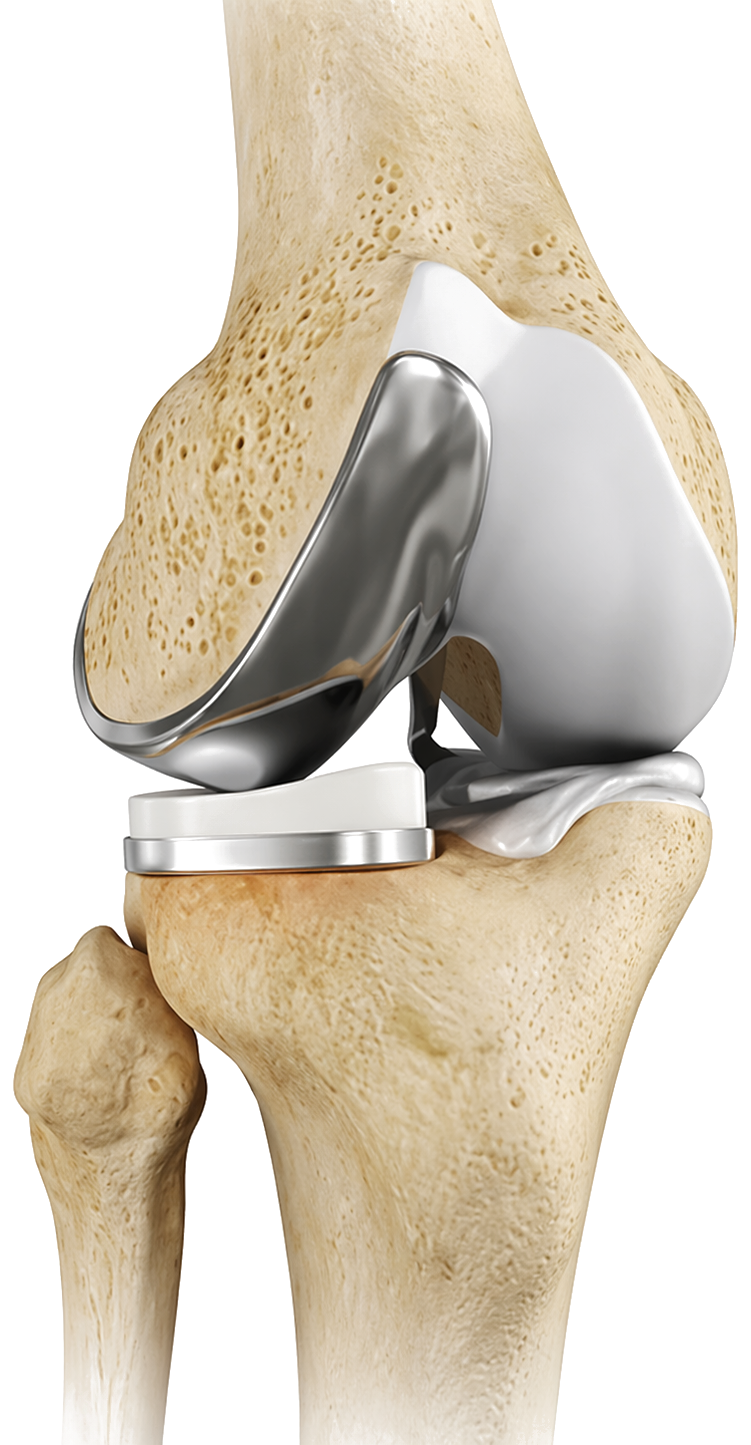
Compartment-sparing knee replacement for single-compartment arthritis, a more natural-feeling knee.
When arthritis affects only one of the three compartments of the knee, most commonly the medial (inner) compartment, a partial knee replacement can resurface only the damaged area, leaving your healthy cartilage, bone, and ligaments completely intact.
Because the anterior and posterior cruciate ligaments are preserved, a partial knee typically feels more like a natural knee than a total replacement. Recovery is faster, blood loss is lower, and return to activity is quicker, but patient selection is critical.
Weight-bearing X-rays, MRI, and clinical exam are used to confirm that arthritis is truly limited to one compartment, that ligaments are intact, and that alignment is correctable.
A pre-operative CT scan builds a 3D model of your knee. The implant is sized and positioned to match your native anatomy before surgery begins.
A 3–4 inch incision, much smaller than a total knee. The kneecap is gently retracted rather than everted, preserving the extensor mechanism.
Only the damaged compartment is resurfaced. The other two compartments, both cruciate ligaments, and the kneecap are untouched.
Timelines are typical, individual recovery varies based on age, health status, pre-operative condition, and adherence to physical therapy. Dr. Debbi will give you a personalized recovery plan.
Two other surgeons told me I needed a total knee. Dr. Debbi reviewed my MRI and said a partial would work. Recovery was remarkably fast, home the same day, driving at two weeks, skiing by the next winter. The knee feels like mine.
What I appreciated most was that Dr. Debbi didn't oversell. He walked me through when a partial holds up and when it doesn't. Six months out, I don't think about the knee. It bends like it always did.