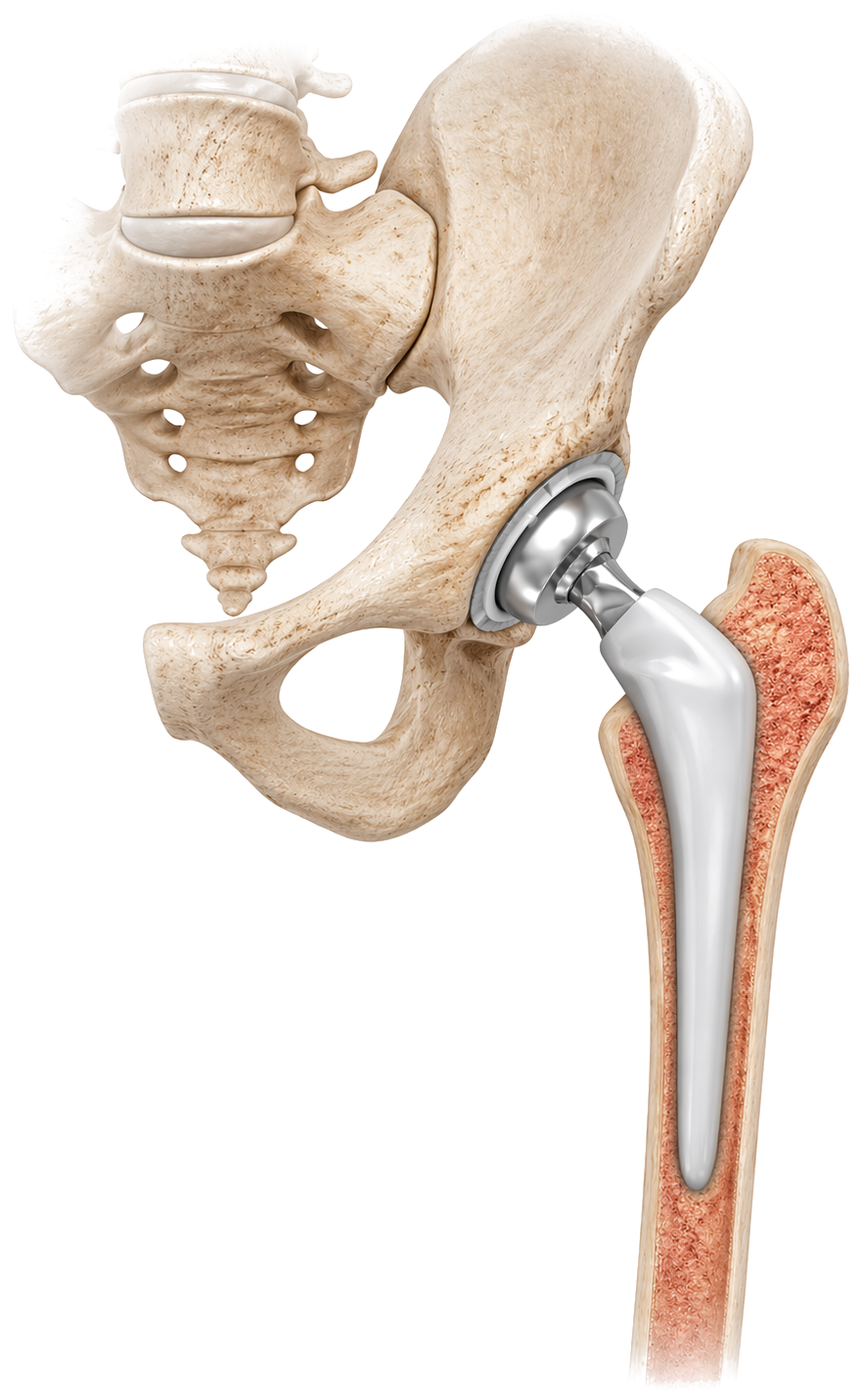
Complex reconstruction when a previous replacement has failed.
Revision surgery is performed when a previous hip or knee replacement has failed, from infection, loosening, instability, implant wear, or fracture around the implant. These cases are technically demanding and require specialized implants, advanced imaging, and careful pre-operative planning.
Dr. Debbi's biomechanical and engineering background is particularly valuable in revision surgery, where implant selection, bone preservation, and soft-tissue balancing are substantially more complex than in a primary replacement. Every revision case is planned as a unique reconstruction.
Advanced imaging (CT, MRI with metal-suppression), laboratory studies, and sometimes joint aspiration are used to identify the cause of failure, without which revision is rarely successful.
Templating, 3D reconstruction, and implant selection are individualized to your bone quality, soft-tissue status, and specific mode of failure.
The failed implants are carefully extracted with specialized instruments, preserving as much native bone as possible. In infected cases, a two-stage approach may be required.
New components, often revision-specific implants with augments, cones, or sleeves, are placed to restore stability, alignment, and leg length. Bone graft or metal augments may be used where bone loss is significant.
Timelines are typical, individual recovery varies based on age, health status, pre-operative condition, and adherence to physical therapy. Dr. Debbi will give you a personalized recovery plan.
My first hip, done at another hospital, loosened after twelve years. Two surgeons declined. Dr. Debbi reviewed the case, built a custom plan, and handled the bone loss with a graft. I'm back to walking two miles a day. I have my life back.
Revision surgery is scary, you've already been through it once and it failed. Dr. Debbi was honest about what could and couldn't be fixed. He got me a stable, pain-free knee. That's what I needed.