Procedures  ›  Hip

The Bikini Incision Hip Replacement

A muscle-sparing anterior hip replacement placed along the natural crease of the groin, so the scar sits where swimwear and underwear cover it.
Muscle-sparingHidden scarSame-day walkingNo hip precautions
Same day
Most patients walk within hours of surgery
2 weeks
Typical return to driving
None
Hip precautions after surgery
3–4 in
Incision, along the natural skin crease
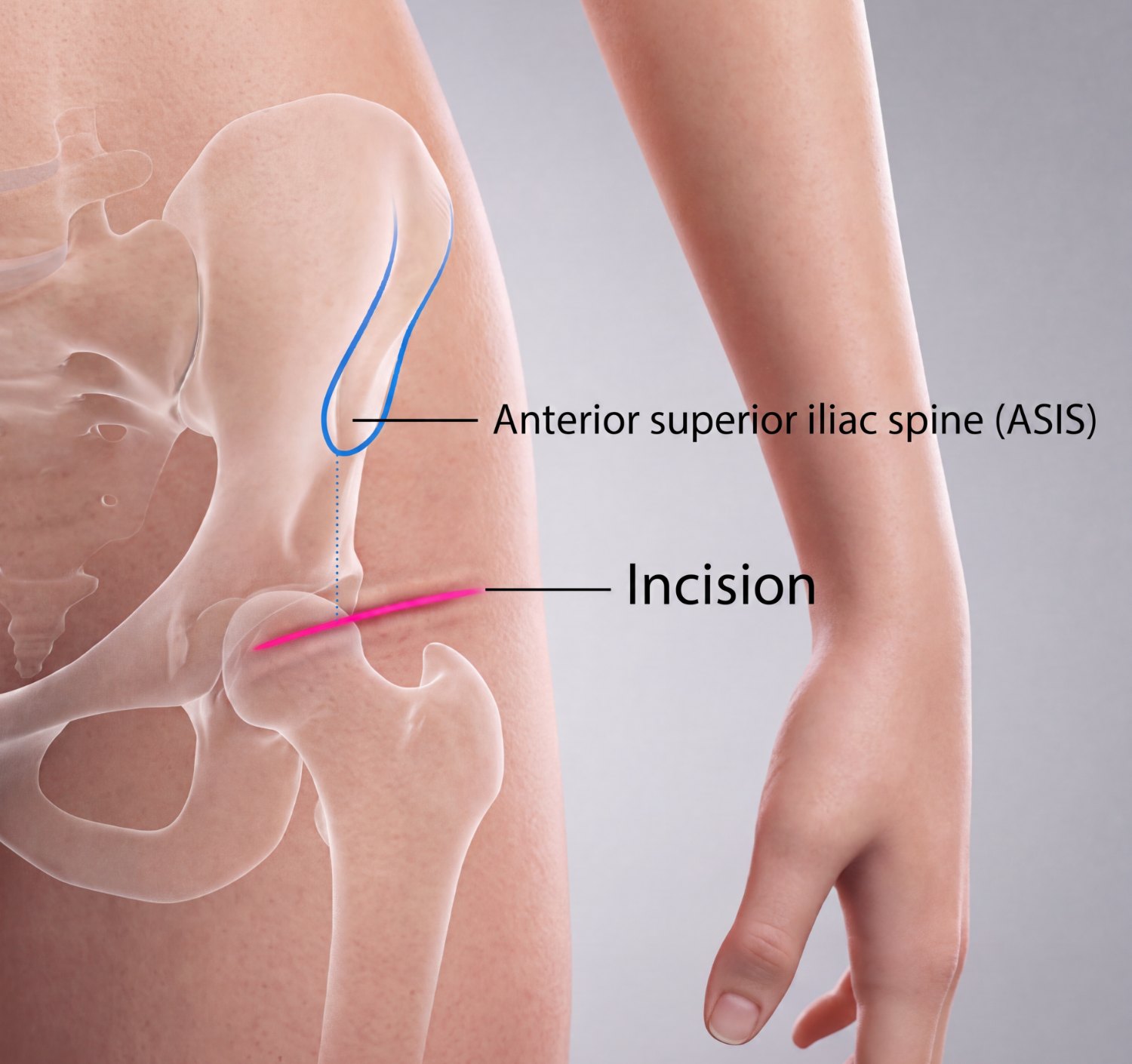
Where the incision sits
Illustration of the hip showing the anterior superior iliac spine and the oblique bikini incision placed low in the groin crease
The incision is placed on a diagonal, just below the crease at the top of the thigh, where clothing naturally covers it.
Overview

The bikini incision is a refinement of the direct anterior hip replacement. The surgery underneath is the same muscle-sparing operation, but the incision is oriented differently, running diagonally along the natural crease of the groin rather than straight down the thigh.

Because the incision follows the natural line of the groin rather than cutting across it, the tissue tends to be less irritated and the wound settles more comfortably, which supports the quick recovery the anterior approach is known for. Because of where it sits, the scar stays hidden under a swimsuit, shorts, or low-rise clothing.

How it compares

Bikini incision, anterior

Oblique, along the skin crease
  • Scar sits low and diagonal, hidden by swimwear and underwear
  • Follows the natural grain of the skin, less tension while healing
  • No muscles cut or detached, the surgeon works between them
  • Intra-operative imaging confirms implant position and leg length
  • No hip precautions, you may bend and cross your legs immediately

Traditional posterior approach

Vertical, on the side or back of the hip
  • Longer scar on the outer hip, visible in shorts and swimwear
  • Crosses the skin's natural lines, often heals wider
  • Gluteal muscles and external rotators are divided and repaired
  • Hip precautions commonly required for the first 6 weeks

Both approaches are excellent operations in experienced hands, and the posterior approach remains the right choice for some patients. Dr. Debbi will tell you directly which approach suits your anatomy.

Technique
01

3D pre-operative planning

A CT scan of your hip is used to build a patient-specific model. Implant size, position, offset, and leg-length correction are all planned in software before you reach the operating room.

02

Marking the crease

The incision is planned on your own anatomy while you are positioned, so it lands in your natural groin crease. This is what keeps the scar hidden.

03

Muscle-sparing exposure

The surgeon works through the interval between the sartorius and tensor fasciae latae. No muscle or tendon is cut or detached, which is why the muscles that control walking and balance have nothing to heal from.

04

Implant placement

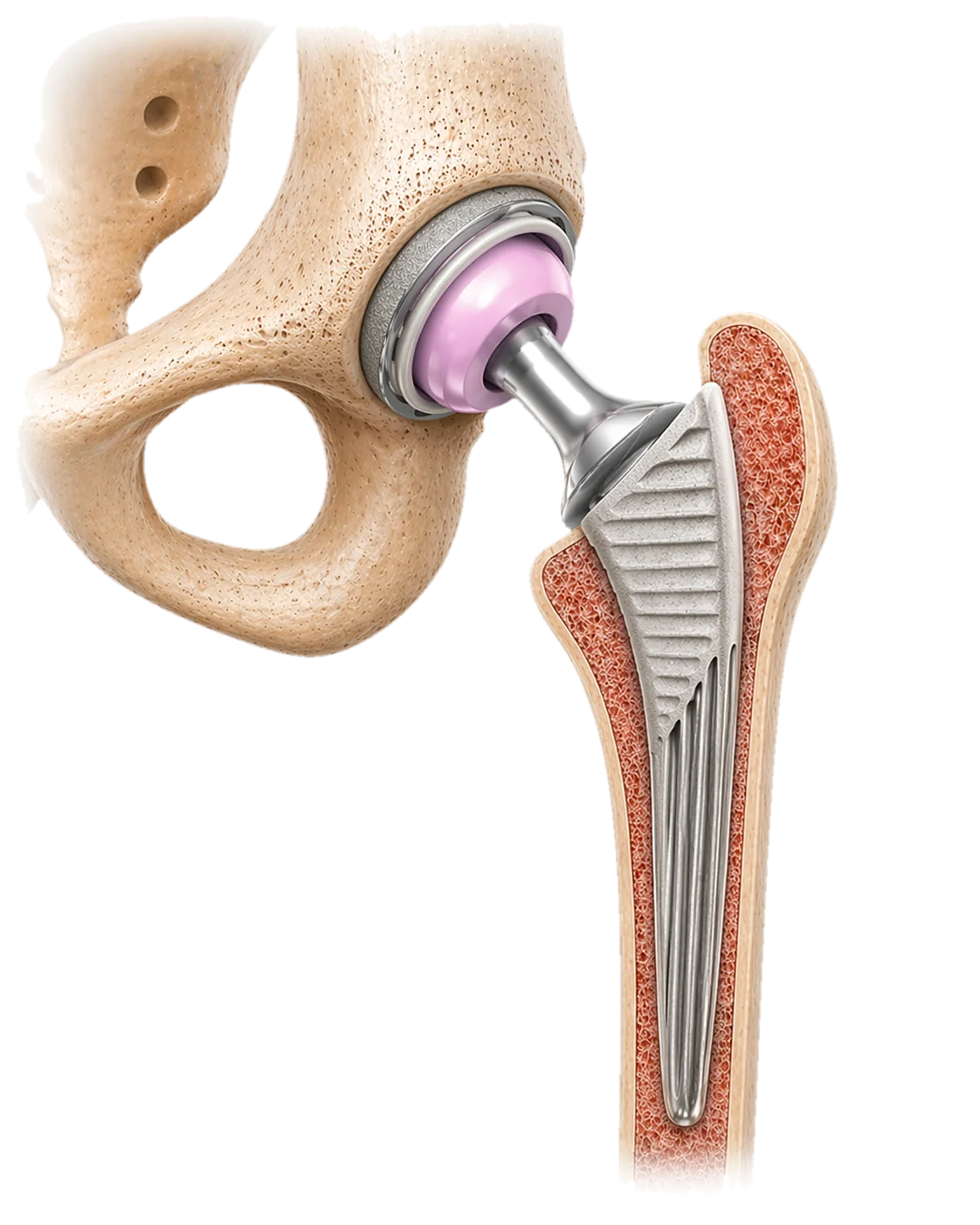
The arthritic femoral head is replaced with a ceramic ball on a titanium stem, and the socket is resurfaced with a precisely oriented cup and bearing liner.

05

Live imaging before closure

A fluoroscopic image confirms implant position, leg length, and offset while you are still on the table. This real-time check is a specific advantage of operating from the front.

06

Layered cosmetic closure

The wound is closed in layers with absorbable sutures beneath the skin, so there are no staples and nothing to remove. A waterproof dressing lets you shower within days.

Recovery timeline
Day 0
Up and walking with a walker or crutches, usually within a few hours of surgery.
Day 1
Most patients go home the same day or the following morning.
Week 1
Off narcotics, walking independently at home, showering with the dressing in place.
Week 2
Typically cleared to drive. No hip precautions, you may bend, cross your legs, and sit low.
Week 6
Back to golf, swimming, cycling, travel, and most non-impact activity.
Month 3–6
Return to higher-demand activity. Scar is typically pale and flat by this point and continues to fade for a year.

Timelines are typical, not guaranteed. Individual recovery varies with age, health, the condition of the hip before surgery, and how consistently you do your physical therapy. Dr. Debbi will give you a personalized plan.

Who is a good candidate
  • Hip arthritis that limits your activity despite injections, therapy, or activity modification
  • Active adults in their 40s, 50s, and 60s who intend to stay athletic after surgery
  • Avascular necrosis (AVN) of the femoral head
  • Post-traumatic or inflammatory arthritis of the hip
  • Patients for whom the appearance and position of the scar genuinely matters

Candidacy for the bikini orientation specifically depends on your body habitus and hip anatomy. In patients with a higher body mass index or a deep groin crease, a standard anterior incision may heal more reliably, and Dr. Debbi will recommend that instead rather than compromise on wound healing for cosmetics.

Common questions
The reconstruction inside is the same muscle-sparing anterior hip replacement. What changes is the orientation and position of the skin incision. You get the recovery profile of the anterior approach plus a scar that is better hidden and tends to heal finer.
It runs diagonally in the crease at the top of your thigh, low enough that standard underwear, bike shorts, and most swimwear cover it completely. Dr. Debbi marks the position on your own anatomy in the operating room rather than using a fixed landmark.
Age alone is rarely the deciding factor. What matters is how much the arthritis is limiting your life and whether non-surgical options have been exhausted. Modern implants have shown roughly 90% or better survival at twenty years in large registry studies, so a patient in their 50s can reasonably expect their hip to last decades. Delaying surgery for years while losing muscle, fitness, and mobility carries its own cost.
For the vast majority of anterior patients, no. Because the posterior soft tissues that prevent dislocation are never disrupted, you can bend, cross your legs, and sit in a low chair from day one.
Keep the dressing on as instructed, do not soak the wound, avoid sun exposure on the scar for the first year, and follow the silicone-based scar care Dr. Debbi's office provides once the wound has fully sealed. Not smoking makes a substantial difference to wound healing.
Many patients do, particularly those who are healthy, motivated, and have support at home. Others prefer a single overnight stay. This is decided with you, based on your medical history.
Golf, swimming, cycling, and hiking are typically back around six weeks. Higher-demand activity such as tennis or skiing is usually three to six months. Dr. Debbi will discuss impact sports individually, since running is generally discouraged after hip replacement.
Request a consultation

Find out if you are a candidate.

New patient appointments are typically available within 1–2 weeks. Telehealth consultations available for out-of-state patients.