Procedures  ›  Knee

Muscle-Sparing Knee Replacement

The subvastus approach reaches the knee from beneath the quadriceps, leaving the muscle that straightens your leg intact.

Quad-sparingRobotic-assistedSame-day walkingFaster leg extension
Same day
Walking within hours
Intact
Quadriceps never cut
Days
Straight-leg raise returns
3D
Planned from your CT
How it works
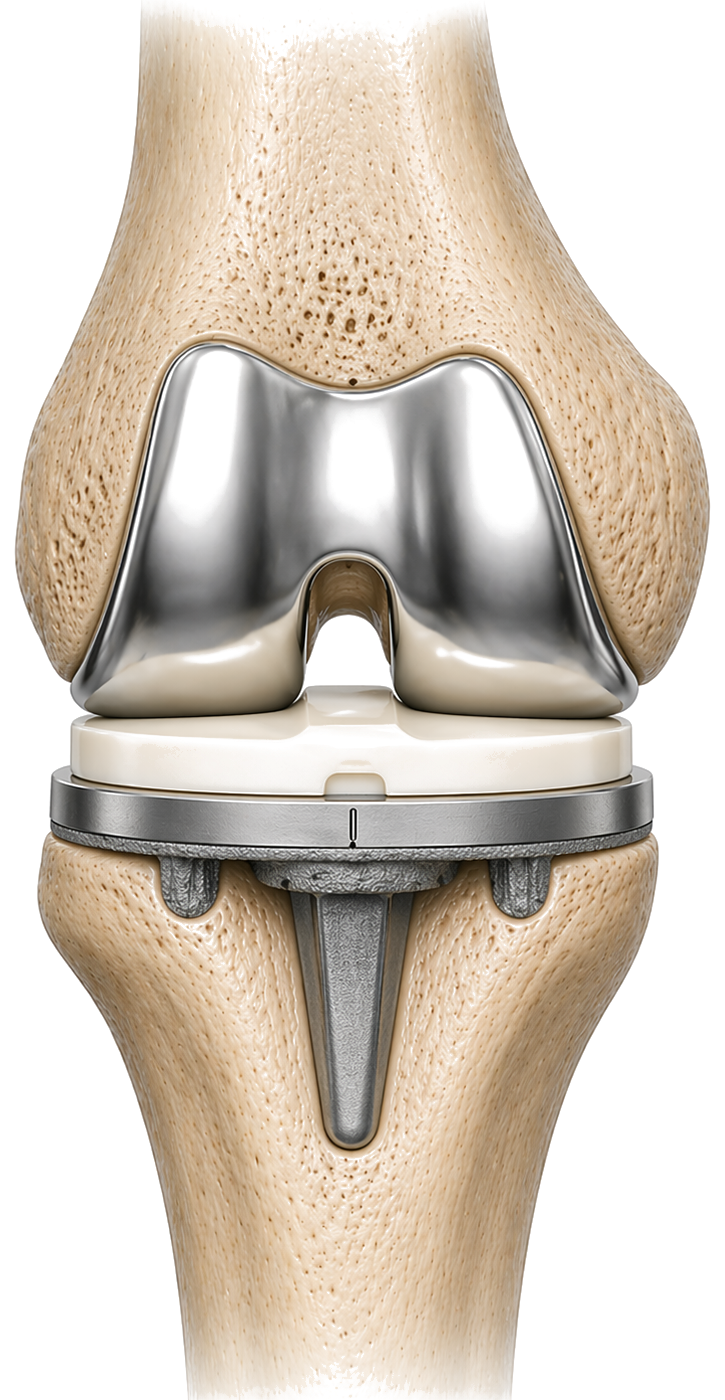
Anatomic illustration of the medial parapatellar and subvastus approaches to the knee
The subvastus approach passes beneath the vastus medialis, leaving the quadriceps tendon above the kneecap intact.
Overview

Every knee replacement needs a path into the joint. The subvastus approach takes that path underneath the muscle on the inner side of your thigh.

That means the tendon above your kneecap is never cut. Dr. Debbi lifts the muscle gently aside and enters the knee from below it, so the muscles that straighten your leg stay intact.

What preserving the muscle means

The quadriceps is the muscle that straightens your leg. It gets you up stairs and steadies the knee with every step, so how fast you regain control of it shapes your early recovery.

Since the tendon is not cut, there is no repair that needs to heal first. Most patients can lift the leg off the bed within a few days and keep good strength through early therapy, so those first sessions go toward regaining motion instead of protecting a repair.

Lifting the muscle rather than splitting it also leaves the tissue around the kneecap undisturbed, so the kneecap usually tracks well on its own.

One thing to be clear about: the implant and how long it lasts are the same either way. What this changes is the first several weeks, and how soon the leg feels like yours again.

Technique
01

3D pre-operative planning

A CT scan of your knee is used to build a patient-specific model. Implant size, rotation, and alignment are planned in software against your own anatomy rather than a generic template.

02

Subvastus exposure

The vastus medialis is elevated off the joint capsule and the knee is entered from beneath it. The quadriceps tendon above the kneecap is left completely intact.

03

Robotic-assisted bone preparation

Robotic guidance executes the plan within a fraction of a degree, which matters more in a muscle-sparing approach where the working window is deliberately smaller.

04

Soft-tissue balancing

Ligament tension is measured through the full arc of motion and the plan is adjusted in real time, so the knee is balanced to how it actually moves, not just how it looks on an X-ray.

05

Implant placement

The femoral and tibial components are seated, and the bearing surface is trialled and checked through full flexion and extension before final fixation.

06

Layered closure

Closed in layers with absorbable sutures beneath the skin, so there are no staples and nothing to remove. A waterproof dressing lets you shower within days.

Recovery timeline
Day 0
Up and walking with a walker, usually within a few hours of surgery.
Day 1–3
Most patients go home. Active straight-leg raise typically returns in this window, which is the clearest sign the quadriceps was preserved.
Week 1–2
Off narcotics, walking independently at home, working on full extension and early flexion.
Week 3–4
Typically cleared to drive once you have quadriceps control and are off narcotics.
Week 6
Back to golf, swimming, cycling, and most non-impact activity. Range of motion usually near functional.
Month 3–6
Return to higher-demand activity. The knee continues to improve and settle for a full year.

Timelines are typical, not guaranteed. Individual recovery varies with age, health, the condition of the knee before surgery, and how consistently you do your physical therapy. Dr. Debbi will give you a personalized plan.

Who is a good candidate
  • Knee arthritis affecting more than one compartment that has failed injections and therapy
  • Active adults in their 40s, 50s, and 60s who want the fastest possible return of leg strength
  • Patients returning to physically demanding work who cannot afford a long quad recovery
  • Post-traumatic or inflammatory arthritis of the knee
  • Patients with reasonable pre-operative motion and no significant prior knee surgery

The subvastus approach suits many knees but not all of them. A very stiff knee, a significant deformity, substantial prior surgery, or a heavily muscled thigh may call for a different exposure, since accurate implant position matters far more to your long-term result than the muscle plane used to reach the joint. Schedule an appointment with Dr. Debbi to discuss which approach is right for you.

Common questions
It means the quadriceps tendon is never cut. The vastus medialis muscle is lifted and the knee is entered from underneath it, so the extensor mechanism, the muscle and tendon that straighten your leg, stays intact.
No. The implants, the bone preparation, and the expected lifespan are the same. What differs is the path taken to reach the joint, which shapes your early recovery rather than the long-term result.
Age alone is rarely the deciding factor. What matters is how much the arthritis limits your life and whether non-surgical options have genuinely been exhausted. Modern knee implants show roughly 90% or better survival at twenty years in large registry data. Delaying for years while losing muscle, fitness, and mobility carries a real cost of its own.
The measurable benefit is concentrated in the first six to twelve weeks, with an earlier straight-leg raise and good early quadriceps strength. By one year, published results are similar across approaches. It is best understood as an easier start rather than a different destination.
Yes. Dr. Debbi pairs the subvastus approach with robotic-assisted planning and execution. Accuracy matters a great deal when the exposure is smaller, so the two techniques complement each other well.
Many patients do, particularly those who are healthy, motivated, and have support at home. Others prefer a single overnight stay. This is decided with you, based on your medical history.
Golf, swimming, cycling, and hiking are typically back around six weeks. Doubles tennis and skiing are usually a three to six month conversation. Running and high-impact sport are generally discouraged after knee replacement, and Dr. Debbi will talk through your specific activities honestly.
Request a consultation

Find out if you are a candidate.

New patient appointments are typically available within 1–2 weeks. Telehealth consultations available for out-of-state patients.